
MARKETING STRATEGY
Why the First 5 Photos Make or Break Your Listing
2026 guide · 7 min read · By Jason Koford
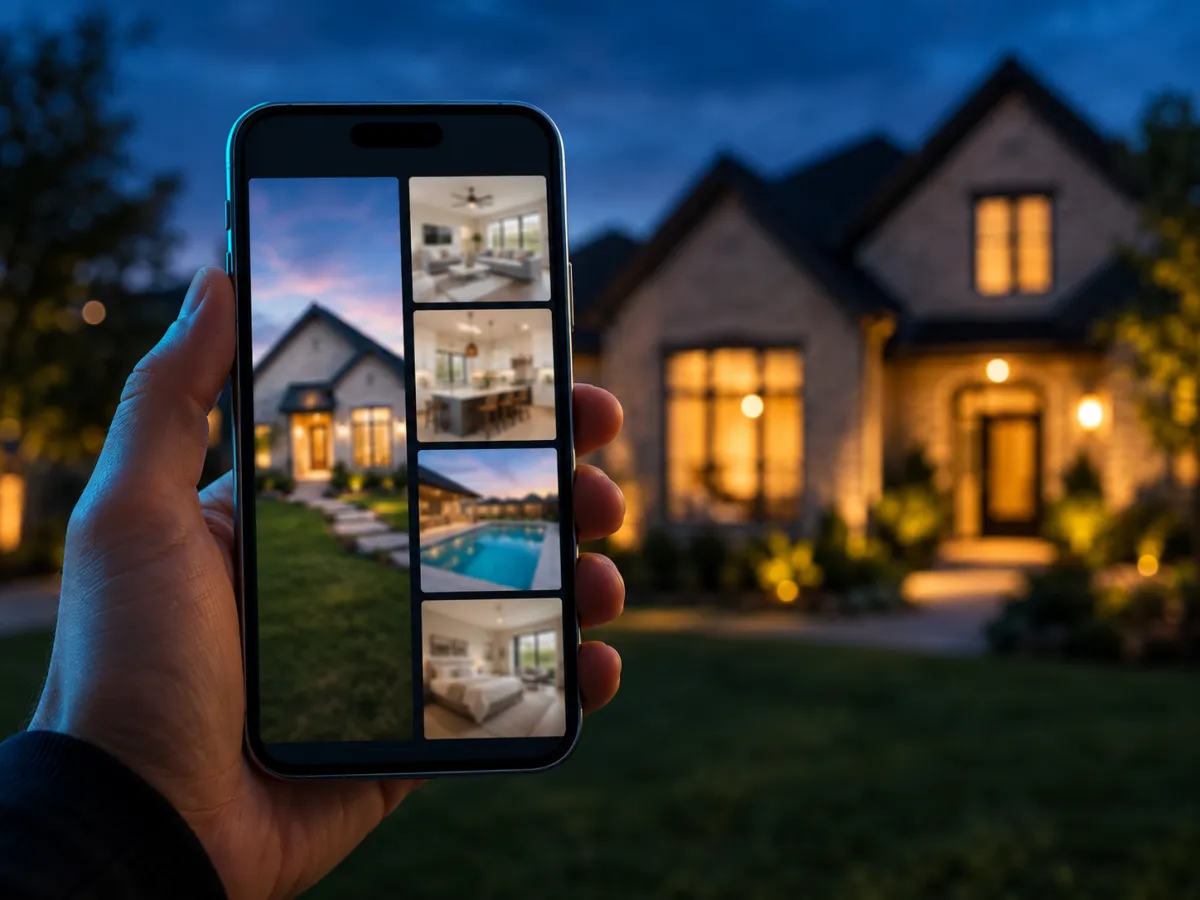
Pull up any listing on Zillow. Before you scroll, before you read a word of the description, before you even register the price — you see five photos. One large hero on the left, four smaller frames stacked on the right, and a button in the corner that says See all 36 photos.
Thirty-one photos are behind that button. And a click is a decision your first five have to earn. You didn't deliver 36 photos to the market — you delivered five, and the other thirty-one are a reward for buyers who already decided they were interested.
Zillow, Realtor.com, Airbnb, and Vrbo all made the same product decision: show a curated handful, hide the rest behind a click. This guide covers which five photos belong in that window, in what order, and the ordering mistake we see on most DFW listings.
Why Do the First 5 Photos Matter So Much?
Because that's all the market sees. Listing photo order is the sequence in which a property's images appear in the MLS feed — and that sequence decides which five photos a buyer sees on Zillow, Realtor.com, Airbnb, or Vrbo before they click anything. Every major platform caps the opening view at roughly five images and collapses the rest behind an interaction. The layout differs slightly; the constraint doesn't.
Zillow
Leads with a hero image and a grid of four, then collapses everything else into a "See all photos" overlay. On mobile the gallery becomes a swipeable carousel — the first few frames are what a thumb sees before it flicks past.
Realtor.com
Same pattern: a dominant primary image with a small grid of supporting shots, and the full set one tap away. Photo order is pulled from the MLS feed, so whatever you set in NTREIS is what shows here.
Airbnb
The most literal version of it — the listing page is a five-photo mosaic, one large image and four smaller, with Show all photos in the corner. Airbnb's host guidance has told hosts for years to treat the opening images as a sequence that shows what the whole place feels like, not a pile of styled details.
Vrbo
Does it twice. Once in search results, where your cover photo competes against a dozen other thumbnails in a scrolling feed, and again on the listing page's hero-plus-grid layout.
What a buyer is actually doing
A buyer scrolling a search feed isn't evaluating your home — they're triaging. In two or three seconds they're answering three questions: is this the kind of house I'm looking for, does it look cared for, and is there anything here I can't get from the other eleven listings I have open. Five photos is enough to answer all three, if the five are chosen deliberately. It's nowhere near enough if they overlap.
The gallery a buyer actually sees
Standard portal layout — one hero, four supporting frames, everything else collapsed.
The Mistake: Five Photos of the Same Thing
Here's a real example, and it's a good house — a 4-bed, 3-bath, 2,519 sq ft home in Carrollton at $545,000, listed with 36 photos.
The five that show up before a click: a kitchen hero, a twilight front exterior, a daytime front exterior, a side-yard exterior, and a close-up of the front door. Four of the five visible slots are the outside of the house. From the front, mostly.
AWhat the market sees now
Four of five slots spent on one elevation.
BSame 36 photos, resequenced
One of each. Nothing repeats.
Nothing in set A is a bad photo. The twilight shot is legitimately good. But a buyer scrolling past has now seen the front elevation three times and learned nothing about the primary suite, the living room, the baths, or how the back of the property lives. That isn't a photography problem — it's an ordering problem.
The versions we see most often across DFW:
- Exterior stacking. Front, front at dusk, front from the driveway, front door. One angle, four slots.
- Detail worship. A gorgeous macro of the faucet or the range knobs in slot three, where a room should be.
- MLS default order. Whatever sequence the photos uploaded in, left alone.
- Burying the differentiator. The pool, the casita, the shop, the greenbelt lot — the single reason this listing beats the comps — sitting at photo 22.
The Five-Shot Formula
Your first five should work like a walkthrough at fast-forward. Each frame does a different job. Nothing repeats.
-
The Hook
Front exterior · or twilight
Clean, straight, well lit — or a twilight frame if the architecture and landscaping earn it. This is the photo that has to survive being a thumbnail in a search feed. If the exterior is the home's weakest asset and the interior is the showstopper, lead with the interior. That's a judgment call, not a rule.
-
The Main Living Space
Wide · corner angle
Shot from the corner that shows the most ceiling and the most light. This is where buyers decide whether the house feels big. Openness reads as square footage.
-
The Kitchen
Non-negotiable
It carries the most weight in a buyer's valuation and gives the fastest read on whether the home has been updated. Shoot it with the island or the counter run leading into the frame.
-
The Primary Suite — or Primary Bath
Whichever is stronger
A spa bath with a freestanding tub beats a plain bedroom; a vaulted primary with a sitting area beats a builder-grade bath. One of the two belongs in the top five, and it's the slot agents skip most often.
-
The Differentiator
The reason this listing beats the comps
Whatever makes this house not the other listings. Pool and outdoor living. The covered patio. The view. The three-car with the shop. If nothing jumps out, use the back yard — buyers want to know what's out back, and its absence from the first five reads as something to hide.
Outside, main living, kitchen, private space, and the reason to care — in five frames, with an obvious reason to open the gallery.
Ordering Rules Worth Knowing
Your hero and your thumbnail are the same image
Whatever sits in slot one gets shrunk to a couple hundred pixels in a search feed. Busy compositions and twilight shots with a lot of dark sky can turn to mud at that size. Check how it reads small before you commit.
Mobile changes the math, not the principle
On a phone the gallery is a carousel instead of a grid, so photo one gets more attention and photos two through five get less. That makes the sequence more important, not less: every swipe has to deliver something new, or the thumb stops swiping.
Order once, in the MLS, before syndication
Zillow, Realtor.com, and the portals pull photo order from the feed. Fix it in NTREIS and it's fixed everywhere downstream.
Re-order on a price drop
If you're already cutting price, you've admitted the listing didn't land. Lead with a different photo at the same time. It costs nothing, and the listing re-surfaces to buyers who scrolled past version one.
The First Five, Platform by Platform
| Slot | Zillow / Realtor.com | Airbnb / Vrbo | Why it's there |
|---|---|---|---|
| 01 | Front exterior or twilight | The signature space — pool, deck, view | Survives as a thumbnail |
| 02 | Main living space, wide | Main living space, wide | Sells scale and light |
| 03 | Kitchen | Kitchen | Fastest read on condition |
| 04 | Primary suite or primary bath | Primary bedroom | The filter buyers shop on |
| 05 | The differentiator | Outdoor living or the view | The reason to click |
Layouts vary by platform and device; verify how your listing renders on mobile before launch.
If You're Marketing a Short-Term Rental
Same principle, different weighting — because on Airbnb and Vrbo, guests are booking an experience, not a floor plan.
Lead with the space that sells the stay: the pool, the deck, the view, the room with the fireplace. Then answer what guests actually worry about — where they sleep, where they cook, where they'll spend the evening. Guests filter hard on beds and baths, so a clean, well-lit bedroom belongs in the top five. So does the kitchen, because "can we cook here" is a real question for families.
The other thing STR listings routinely get wrong: no sense of scale in the first five. A tight shot of a beautifully styled corner tells a guest nothing about whether nine people fit. One honest wide frame early builds more trust than five styled vignettes.
The 60-Second Audit
Open your active listings and look at only the visible five.
- Do all five show different parts of the property, or is one area repeated?
- Is the kitchen in there?
- Is a bedroom or bath in there?
- Is the single best feature of this home in there?
- Does photo one still read clearly at thumbnail size?
A no to any of them is a two-minute fix in the MLS. No reshoot, no new spend.
FAQ
How many photos should a listing have?
Enough to cover every room and the exterior without repeating — for most DFW homes that lands somewhere between 25 and 40. But total count matters far less than the order. A 40-photo gallery with four exteriors in the first five underperforms a 25-photo gallery that's sequenced properly.
Should the first photo always be the exterior?
Usually, because buyers orient themselves by the front of the house. The exception is a home whose exterior is unremarkable and whose interior is exceptional — a dated brick ranch with a fully renovated open interior, for example. Lead with the strongest true image of the property.
Does photo order matter if the MLS controls syndication?
That's exactly why it matters. Zillow and Realtor.com pull order from the feed, so the sequence you set in NTREIS is the sequence buyers see across every portal. Fix it once at the source.
Can I change the photo order after a listing goes live?
Yes, and it's worth doing — particularly alongside a price adjustment. Re-ordering takes a couple of minutes and pushes an updated presentation to buyers who scrolled past the first version.
What should the first photo be for a short-term rental?
The space that sells the stay rather than the front of the building — the pool, the deck, the view, the room people picture themselves in. Guests are booking an experience, and on Vrbo especially that cover photo is competing against a dozen thumbnails at once.
Do twilight photos make good hero images?
Often yes, but check them at thumbnail size first. A twilight frame with a lot of dark sky and small windows can turn muddy when a portal shrinks it into a search feed. The best twilight heroes have warm interior light carrying real contrast against the sky.
The Bottom Line
Great photography and great photo ordering are two different services, and most listings only get one of them. You can hand an agent 36 beautifully lit images and still watch the listing underperform, because the five doing the work all showed the same wall of brick.
Kaptiv Media is a real estate photography studio in Southlake, Texas. We shoot every DFW listing with the top five in mind — and every gallery we deliver comes sequenced, not just sorted, so the first five do their job before anyone clicks anything.
Your listing, shot like it's worth more.
Kaptiv Media is booking DFW listings now — HDR photography, cinematic video, FAA Part 107 drone, Matterport, twilight, and MLS-ready floor plans, delivered sequenced and ready to publish.
Book a Shoot with KaptivGet Behind the Lens
Once a month, an inside look at the shoots, listings, and DFW market data shaping Kaptiv's work — plus the strategy top agents are using to sell faster.
No spam. Unsubscribe anytime.
Premium real estate photography, video, and drone coverage for the Dallas–Fort Worth metroplex.

PAGES
CONTACT
FOLLOW
© 2026 Kaptiv Media. All rights reserved.